Activate ambience
Lead Product Designer ยท Dubai

Hi, I'm Prasenjit.

I find the signal in the noise, then design the experience that acts on it.

Career

Property Finder
Lead Product Designer[Mortgage Finder] ยท Dubai, UAE
Now
Proptech ยท Growth ยท Product Design
Previously at
talabat
Sr. Product Designer
2022 โ€“ 2026
PharmEasy
Product Designer
2021 โ€“ 2022
Wellnesys Technologies
Product Designer
2019 โ€“ 2021

Featured Work

View case study โ†’
Fintech ยท Growth
18.8%
Cards from referrals
68%
Welcome bonus uplift
+31%
GMV uplift (NFV)
talabat ร— ADCB ยท 2024โ€“2025
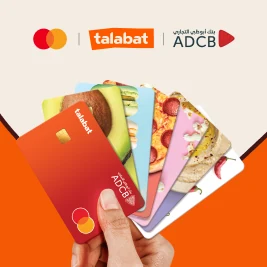
Refer & Earn: Improving acquisitions for the talabat co-branded card
Identified a referral signal in an unrelated research session, validated it lean, navigated a mid-project commercial constraint, and shipped a programme that drove 18.8% of all new card approvals.
Growth Design Fintech Referral Stakeholder Management

What I do

๐ŸŽฏ
Product Strategy
Framing problems as business opportunities, building the case for investment, and aligning stakeholders around outcomes.
๐Ÿ”ฌ
Research & Insight
Finding the signal in the noise. Turning behavioural observations into design hypotheses worth building.
โšก
Growth Design
Acquisition, activation, and referral mechanics. Design that moves the business lever, not just the screen.
๐Ÿงฉ
Systems Thinking
Design systems, service blueprints, and component logic that scale across teams and touchpoints.

Connect with me

Let's build something
people remember.

Open to Design Leadership roles globally.

prasingharevolution@gmail.com
Case Study ยท Fintech ยท Growth Design

From a single Share button to 18.8% of all new card approvals

How I identified a referral signal inside an unrelated research session, validated it with a lean MVP, navigated a mid-project commercial constraint, and shipped a programme that measurably lifted acquisition quality and platform GMV.

18.8%
of new cards issued (Janโ€“May 2025) came from referrals
68%
uplift in welcome bonus qualification for referred vs non-referred users
+23โ€“31%
GMV uplift for active referred users (food +23%, non-food +31%)
My Role
Senior product designer
Team
PM ยท Engineering ยท Data ยท Commercial
Timeline
6 wks design ยท 4 wks build ยท 3 wks pilot ยท ~2โ€“3 months start to launch
Platform
talabat iOS & Android ยท UAE
01 ยท The Problem

New card acquisition was plateauing. We needed to find demand inside the platform itself.

The talabat ADCB co-branded card had strong product value, but two documented problems limited growth: a low overall acquisition rate and a lack of user awareness of the card's benefits. Data showed that 37% of users who tapped "apply now" returned at least 3 times before completing โ€” intent existed, but benefit comprehension was the barrier. The question wasn't whether users wanted the card. It was whether the right users were hearing about it.

37%
of "apply now" tappers returned at least 3ร— before completing โ€” intent was present; benefit comprehension was the blocker
2 problems
documented: low acquisition rate + low user awareness of card benefits, both pointing to the same root cause
02 ยท The Insight

I found the signal in the wrong research session.

During a study on a different project, a recurring pattern emerged: card holders with satisfactory experience consistently showed a tendency to promote the card within their immediate circle โ€” without any incentive. This was not the subject of the research. But it was too consistent to set aside. It became the seed for a hypothesis: if users were already referring informally, what would happen if we made that referral easy, visible, and rewarded?

Documented behavioural observation
"Card holders who had a satisfactory experience seemed to have a tendency to promote the card within their immediate circle without being incentivized to do so." โ€” Research finding, captured during a separate card onboarding study.
03 ยท The Lean Bet

Before asking for a full programme, I needed proof. So I shipped a button.

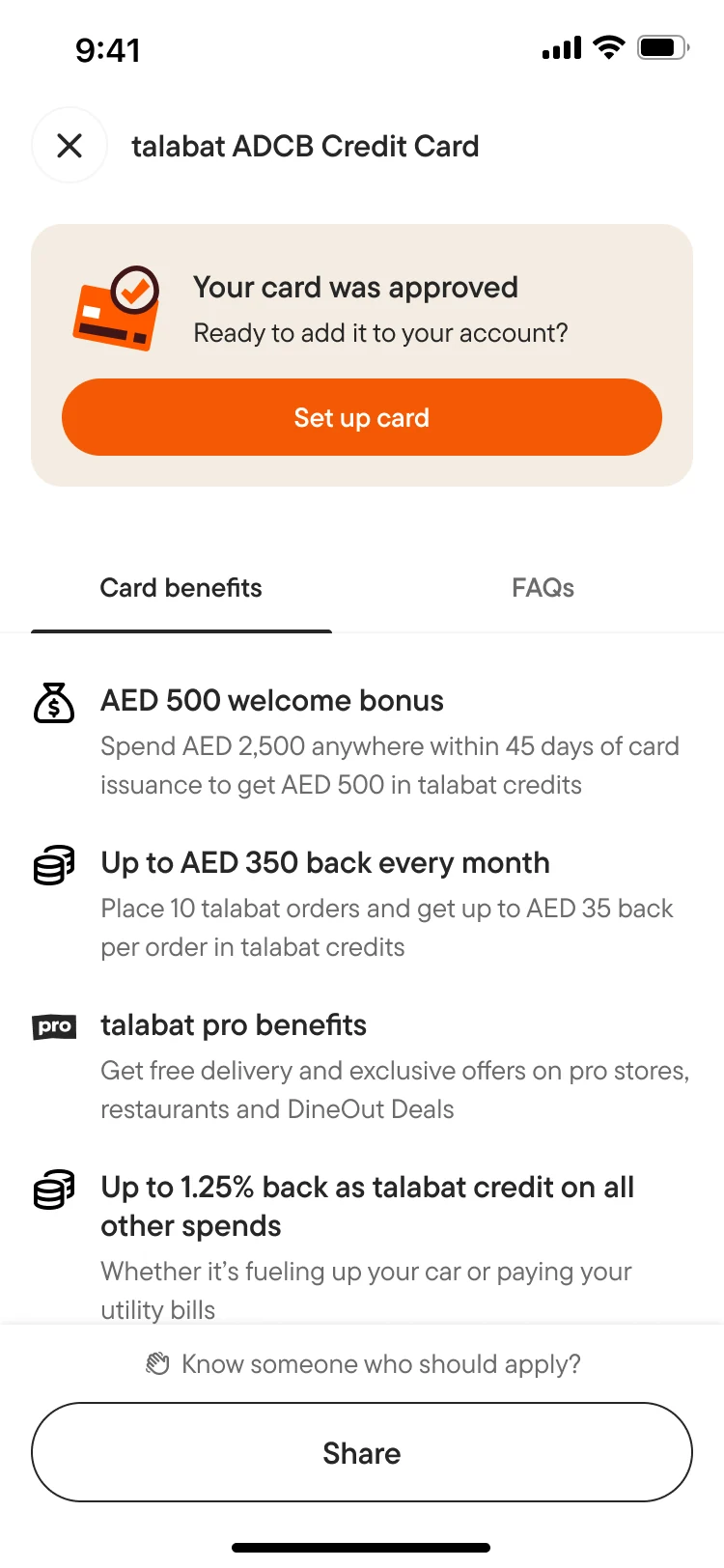
Hypothesis: making it easier for users to share the card by adding a simple "Share" button across the engagement journeys will validate whether a referral programme is worth building. We shipped it with no tracking, no incentives โ€” just friction removal. ~10% of all users visiting the card status page tapped it. That number became the argument. I ran workshops bringing commercial, data, engineering, and product stakeholders together, defined scope, and built the service blueprint for the full programme.

~10%
CTR on the lean "Share" button โ€” a statistically meaningful signal that organic referral behaviour was real and latent
6 weeks
from workshops to end-to-end service blueprint and complete design โ€” sole designer, structured around continuous short feedback loops
Card status screen showing the Share button added in May 2024 as the initial lean validation of the referral concept

the only change
we shipped

no campaign ยท no reward
just friction removed

Card status screen ยท Share button ยท May 2024
04 ยท The Constraint

Mid-project, commercial eliminated the referee reward. Here's what we did instead.

โšก The Strategic Pivot
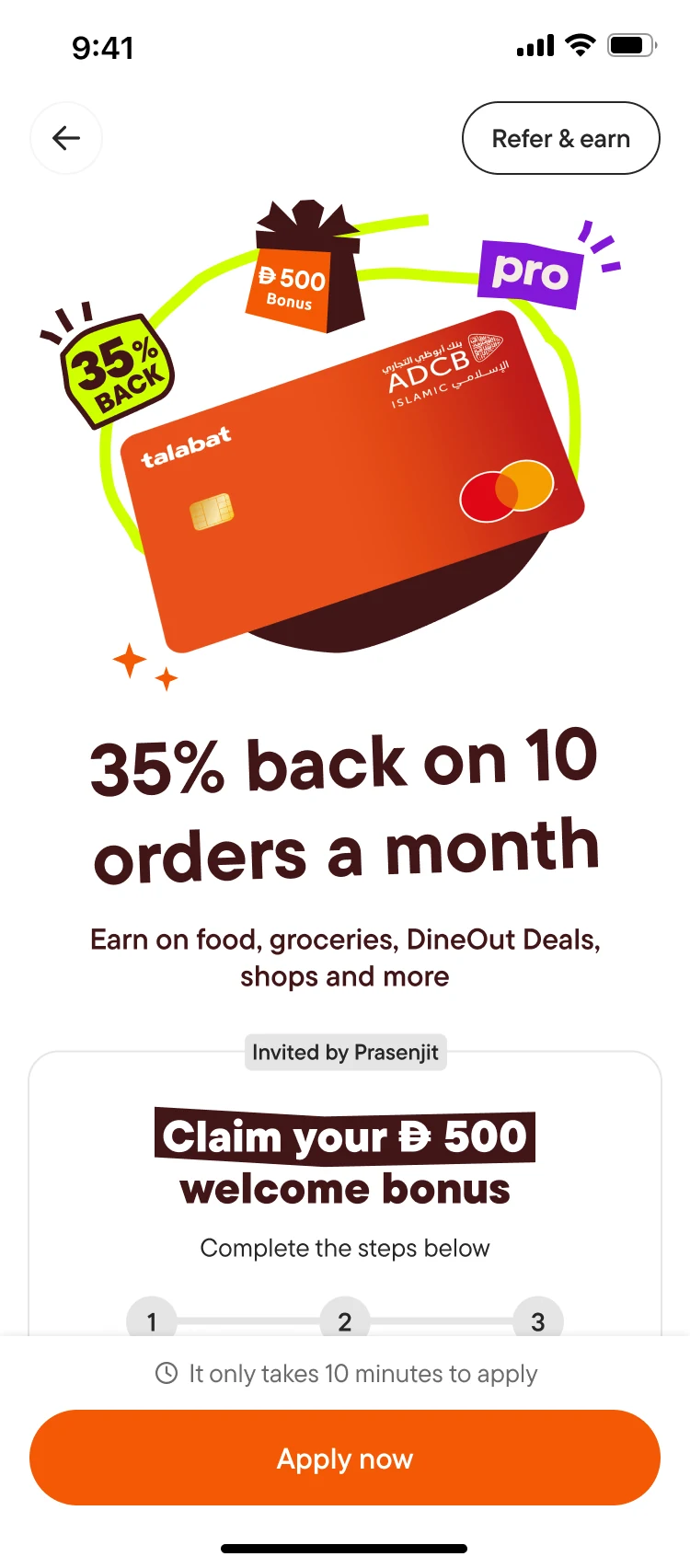
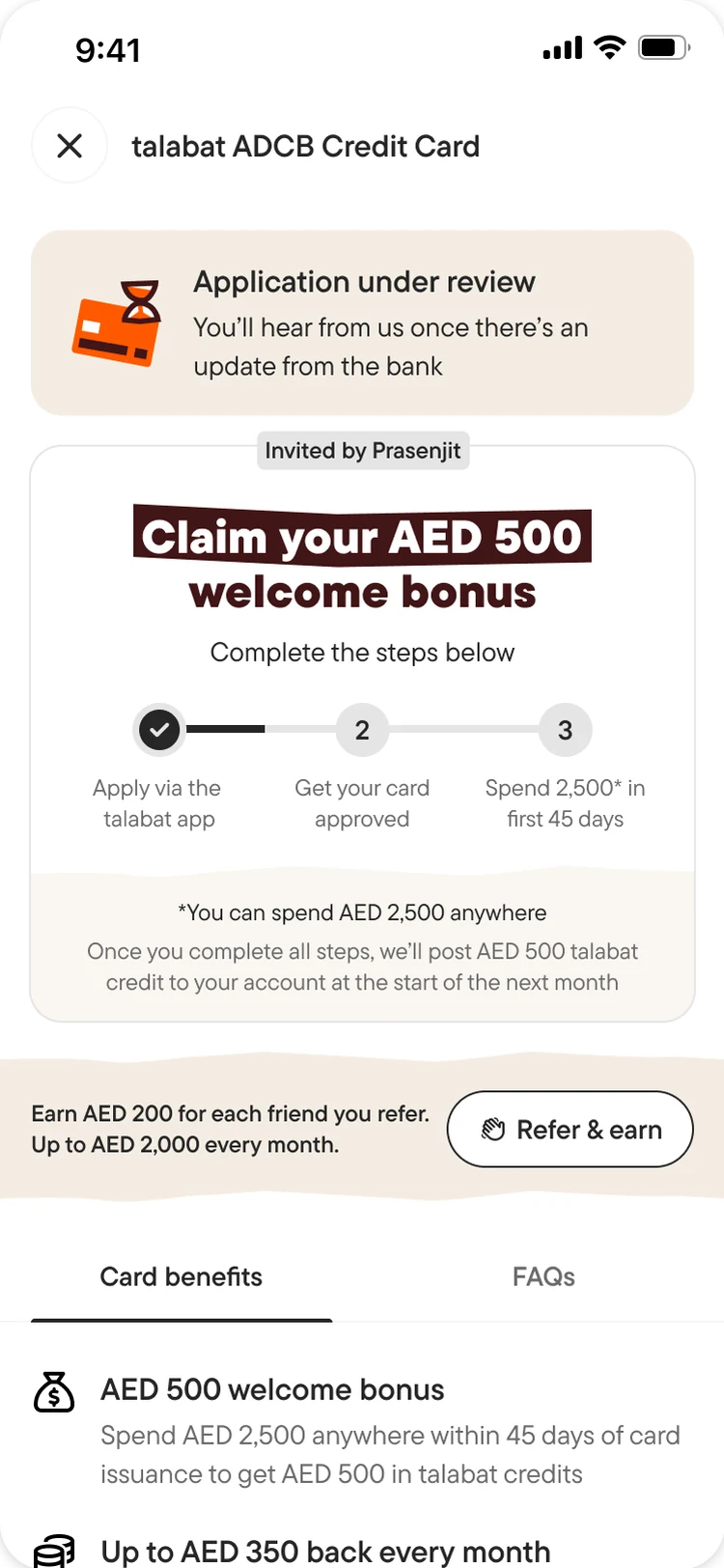
We had aligned on equal rewards for both referrer and referee. During the design process, commercial revised the budget and restricted rewards to the referrer only. Rather than drop the referee-side experience, we repositioned the welcome bonus โ€” a benefit that already existed for all new applicants โ€” as a referral-linked reward for the referee. The hypothesis: referees would be more inclined to complete their application if they perceived it as a rewarding opportunity tied to the referral. We created a 3-step progress tracker to make the welcome bonus visible and tied to the referral context. Referred users saw a 68% uplift in welcome bonus qualification vs non-referred users in the same period.
05 ยท What Shipped

Launched to 100% of UAE users, January 2025.

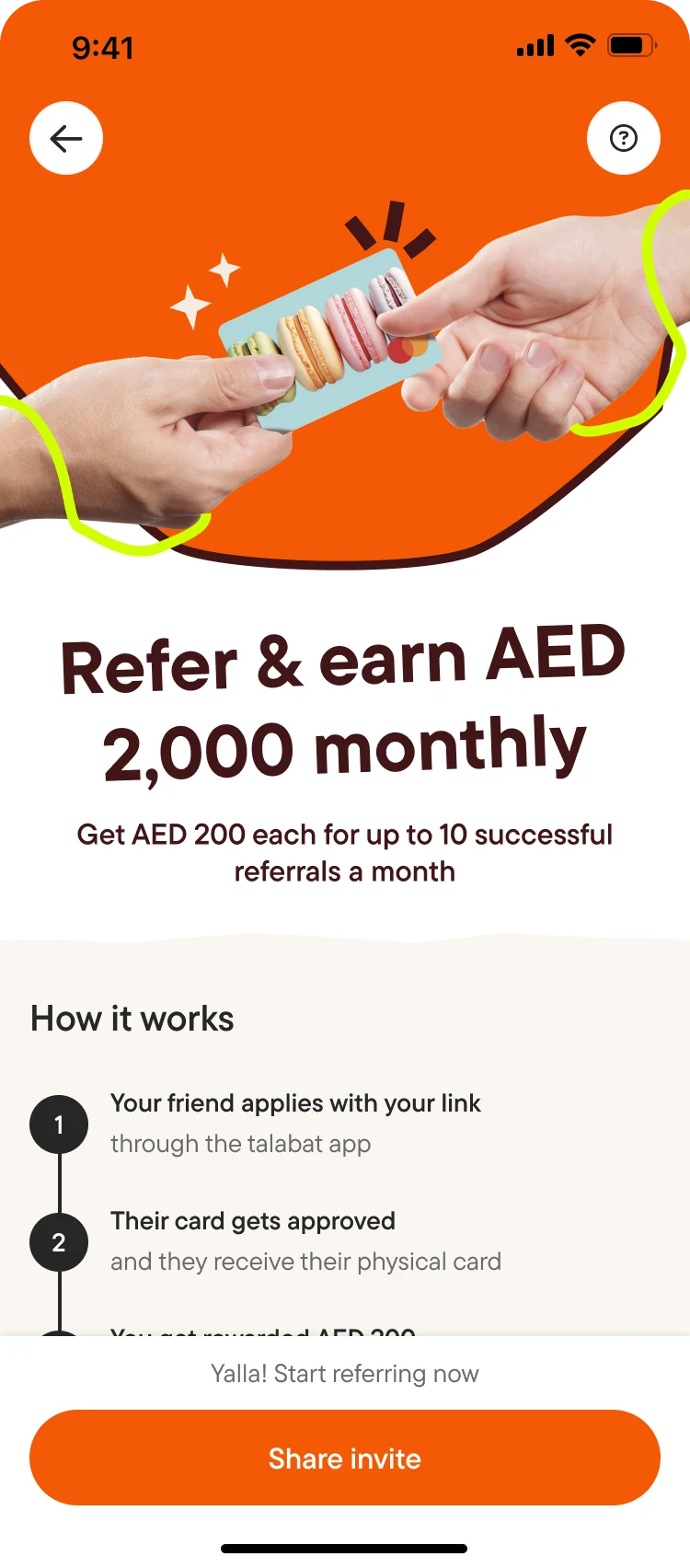
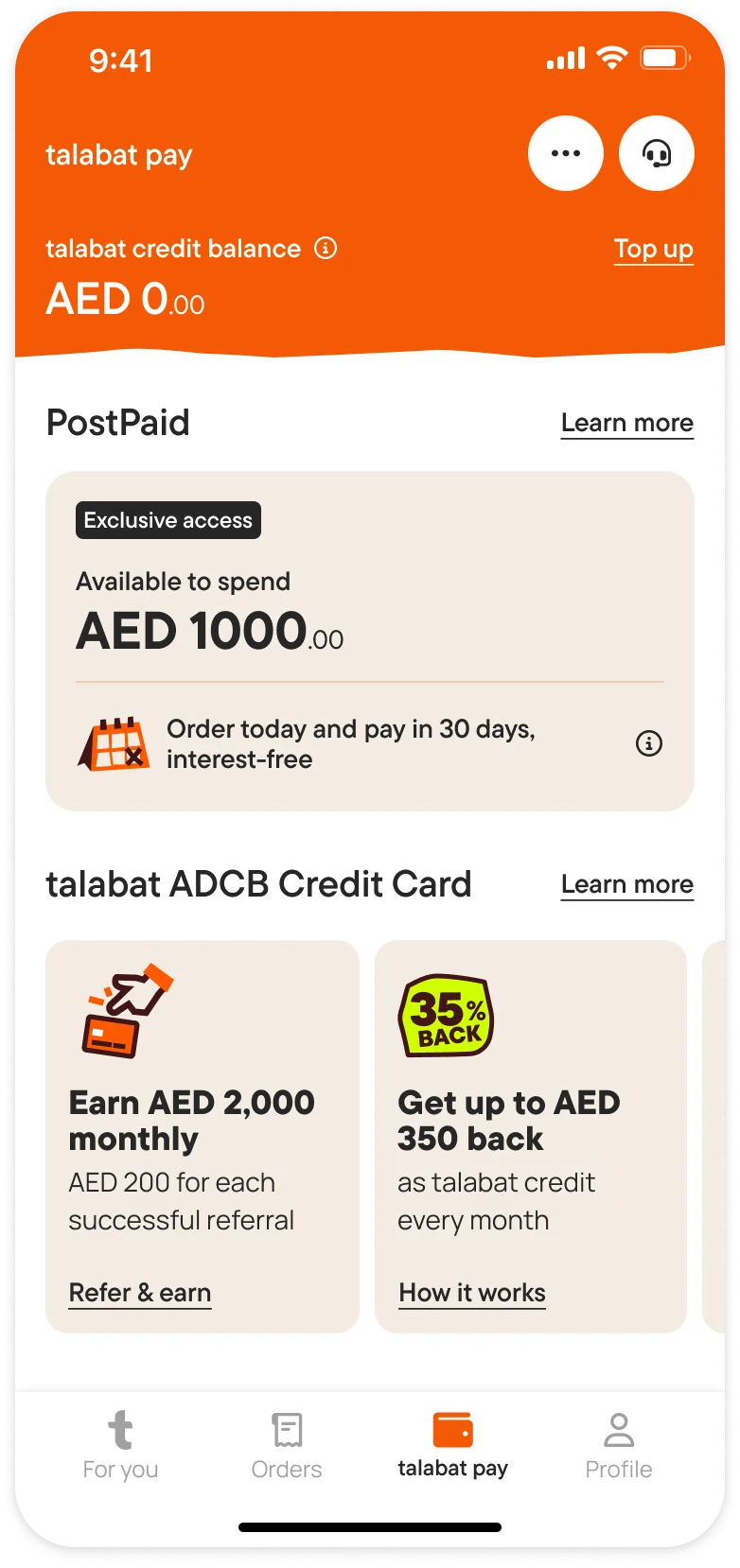
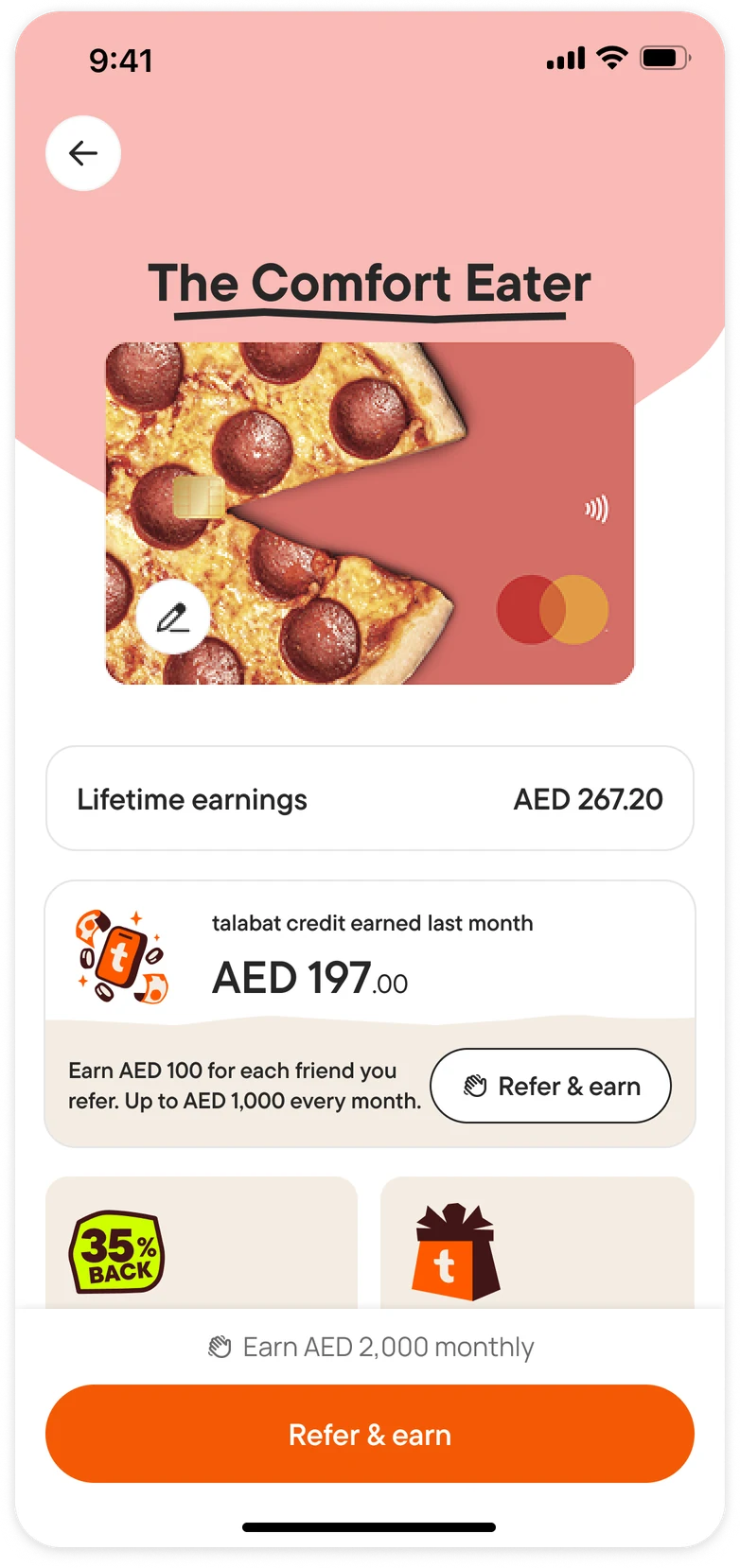
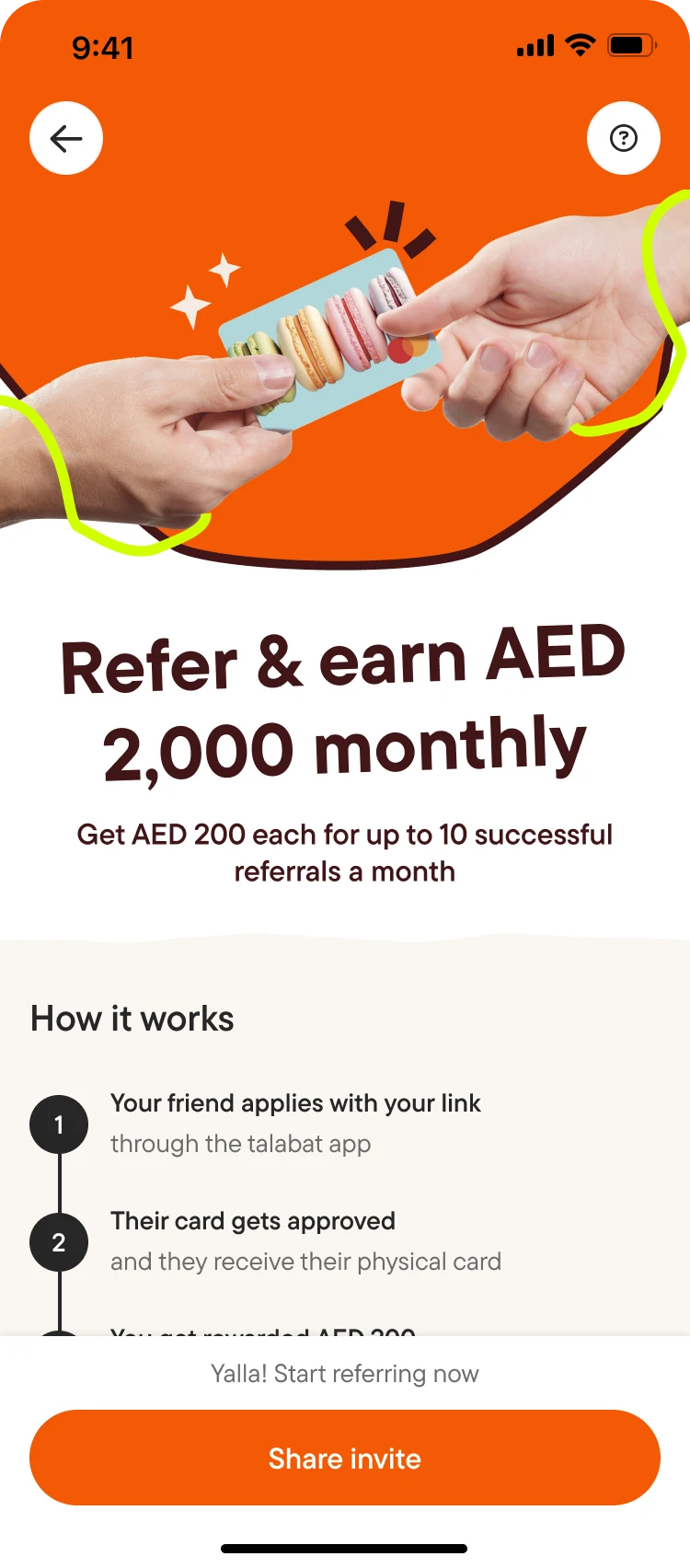
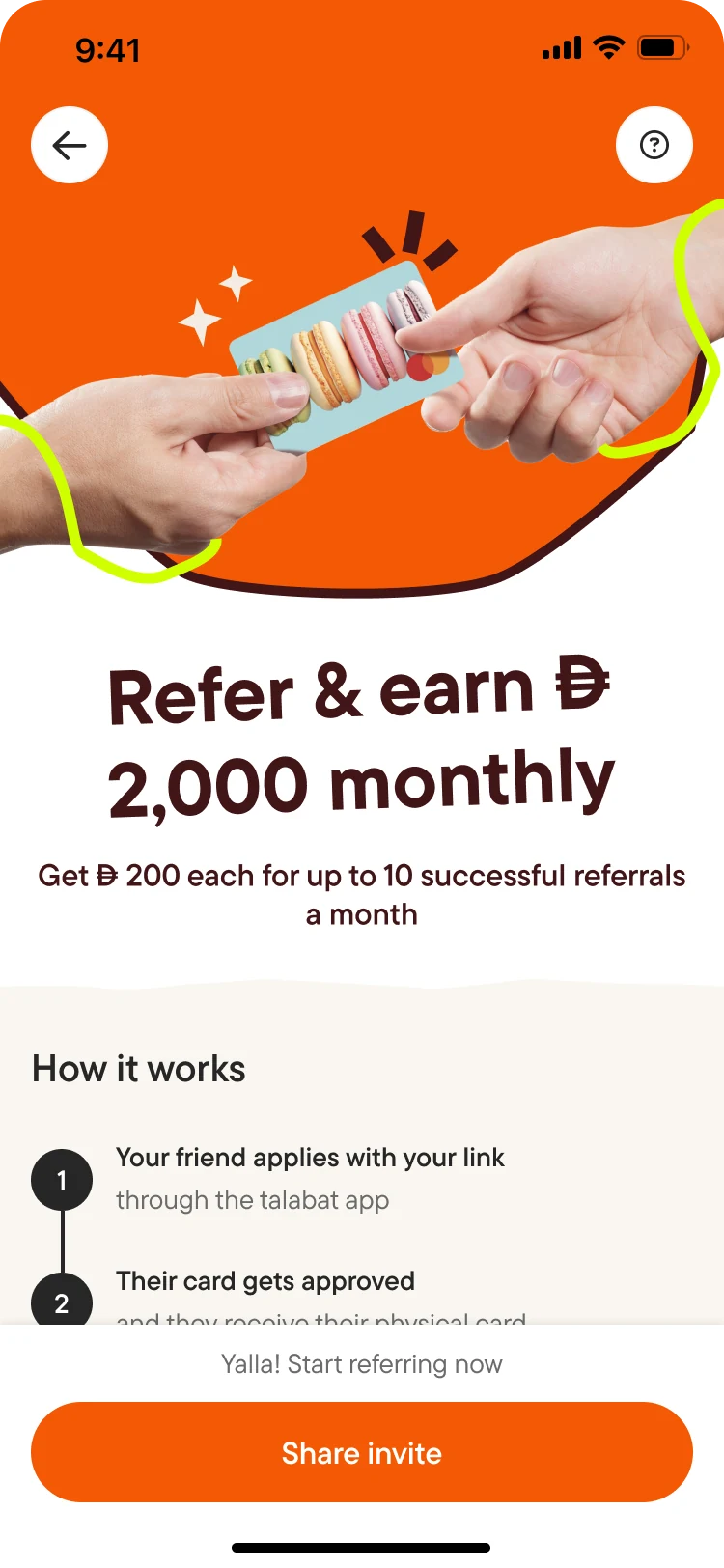
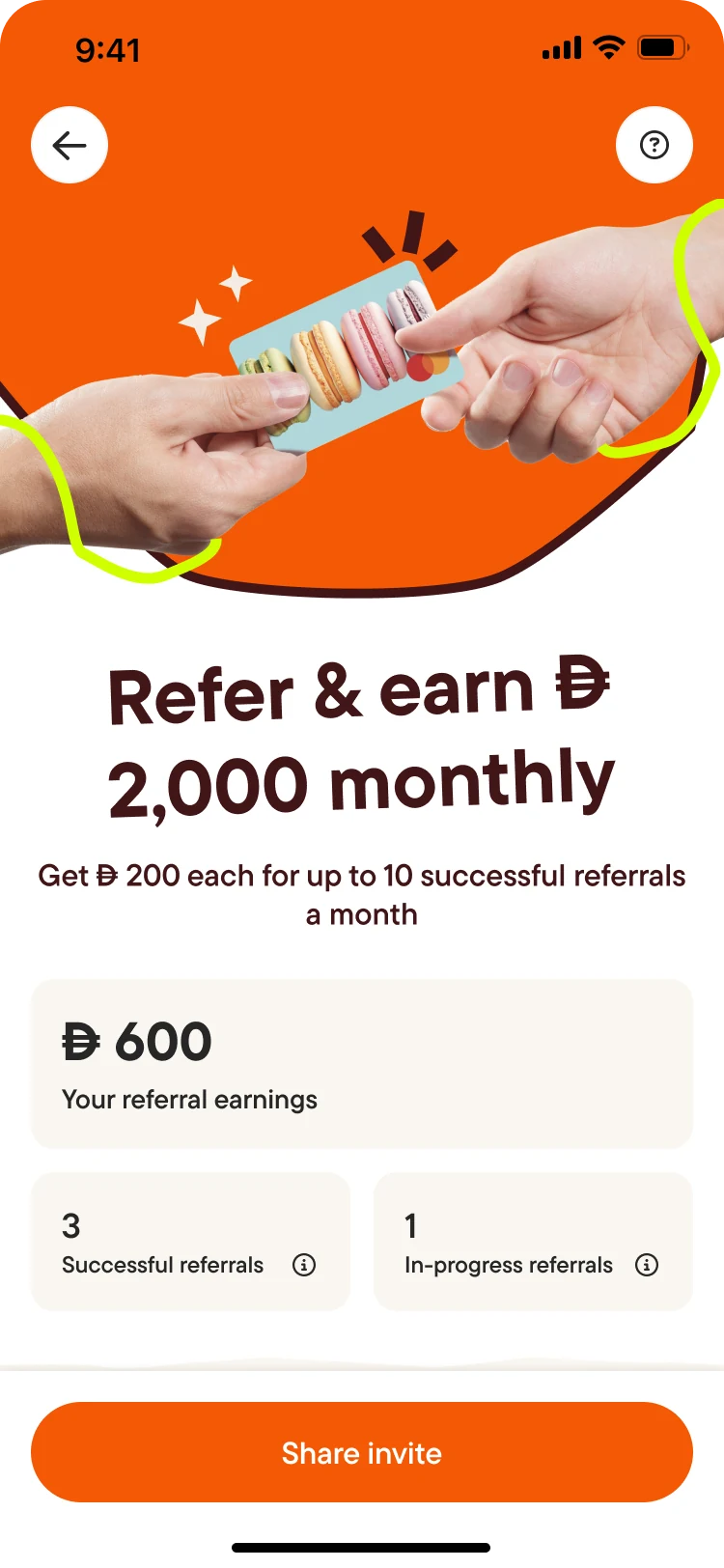
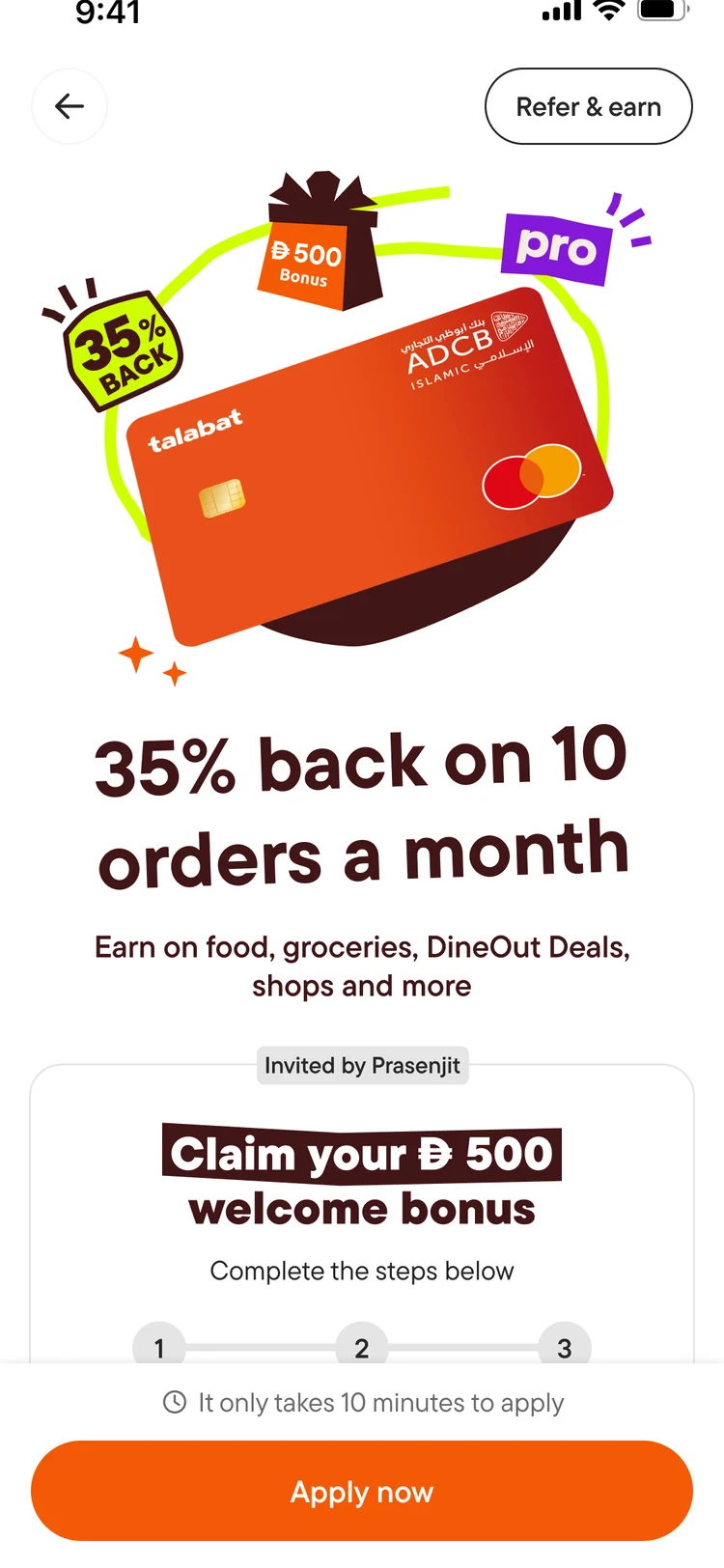
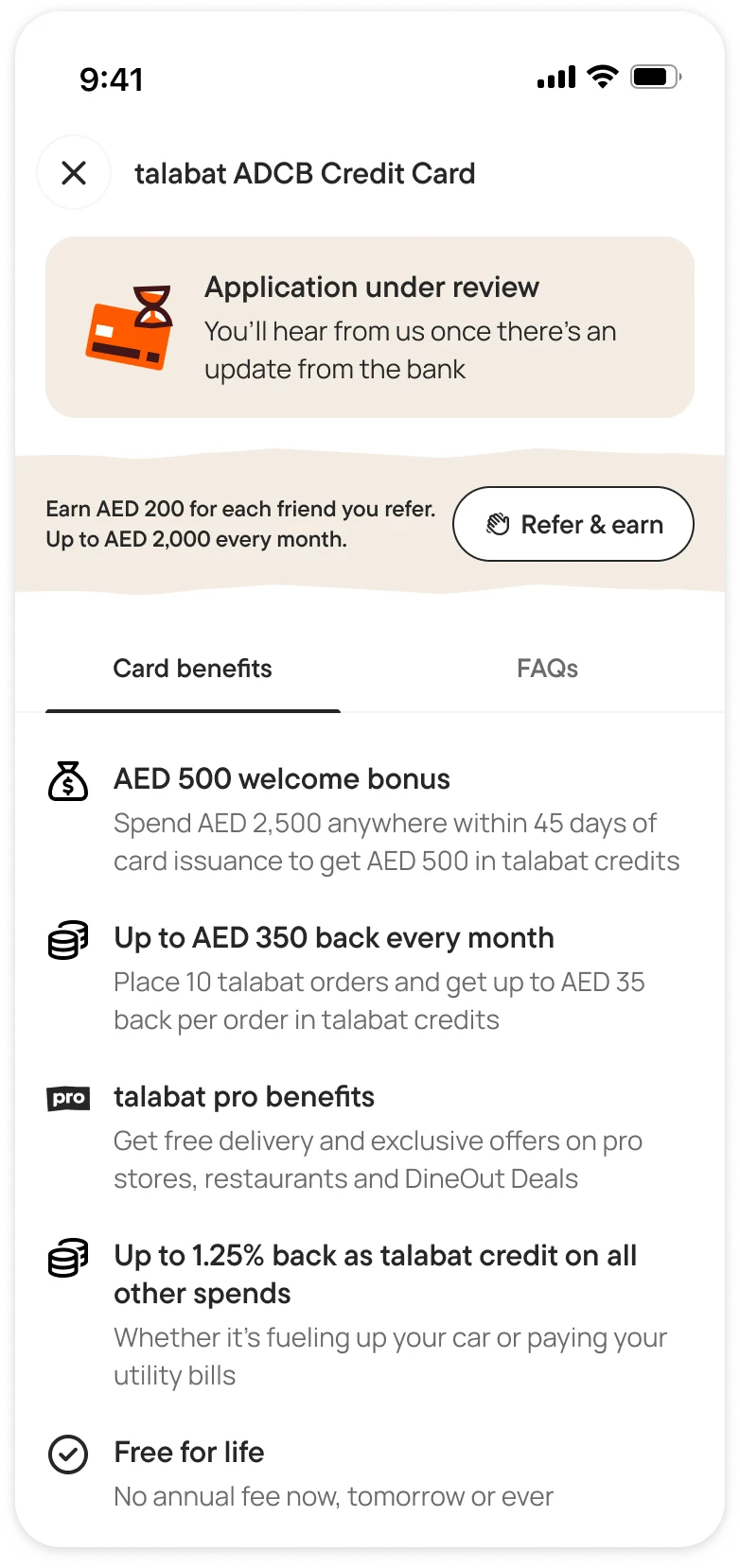
A complete referrer and referee experience: entry points across card engagement journeys, a dedicated landing page, a real-time earnings tracker for the referrer, and a 3-step welcome bonus tracker for the referee.

01
Entry Points
3 contextual entry points surfaced across the card engagement journey: card status screen, post-purchase banner, and account page โ€” meeting users where they are in their usage cycle.
02
RaF Landing Page
Clear value proposition up front: reward amount, eligibility, and how it works in 3 simplified steps โ€” reduced from the original 5-step explainer based on comprehension feedback.
03
Share Flow
One-tap share with multiple channel options. The referral link is pre-loaded with the user's unique referral code โ€” zero effort required to forward.
04
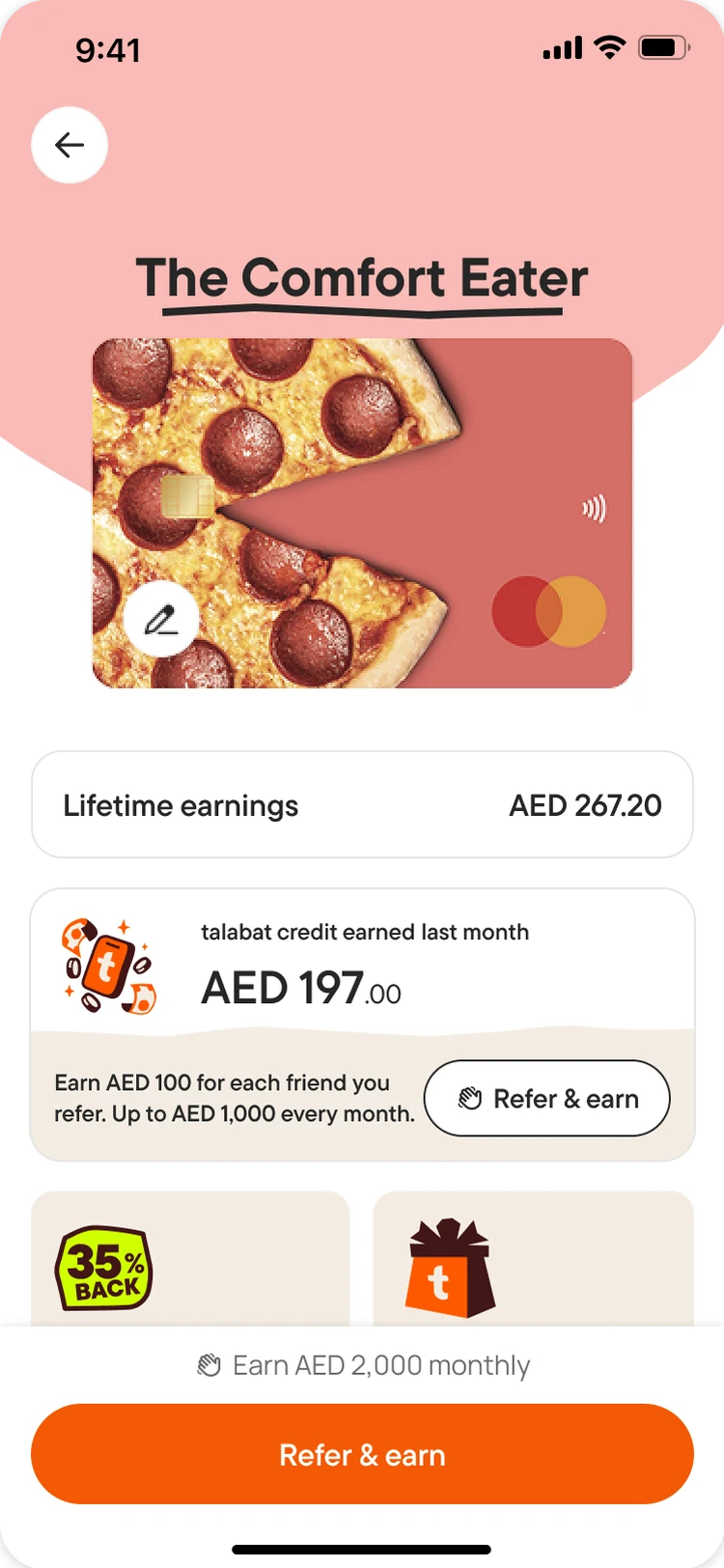
Earnings Tracker
Real-time visibility of referral status and earnings. Prioritises earnings transparency over referee-level detail โ€” based on user research showing referrers care most about their own reward status.
06 ยท Fraud Mitigation & Eligibility

Not every user gets the same screen.

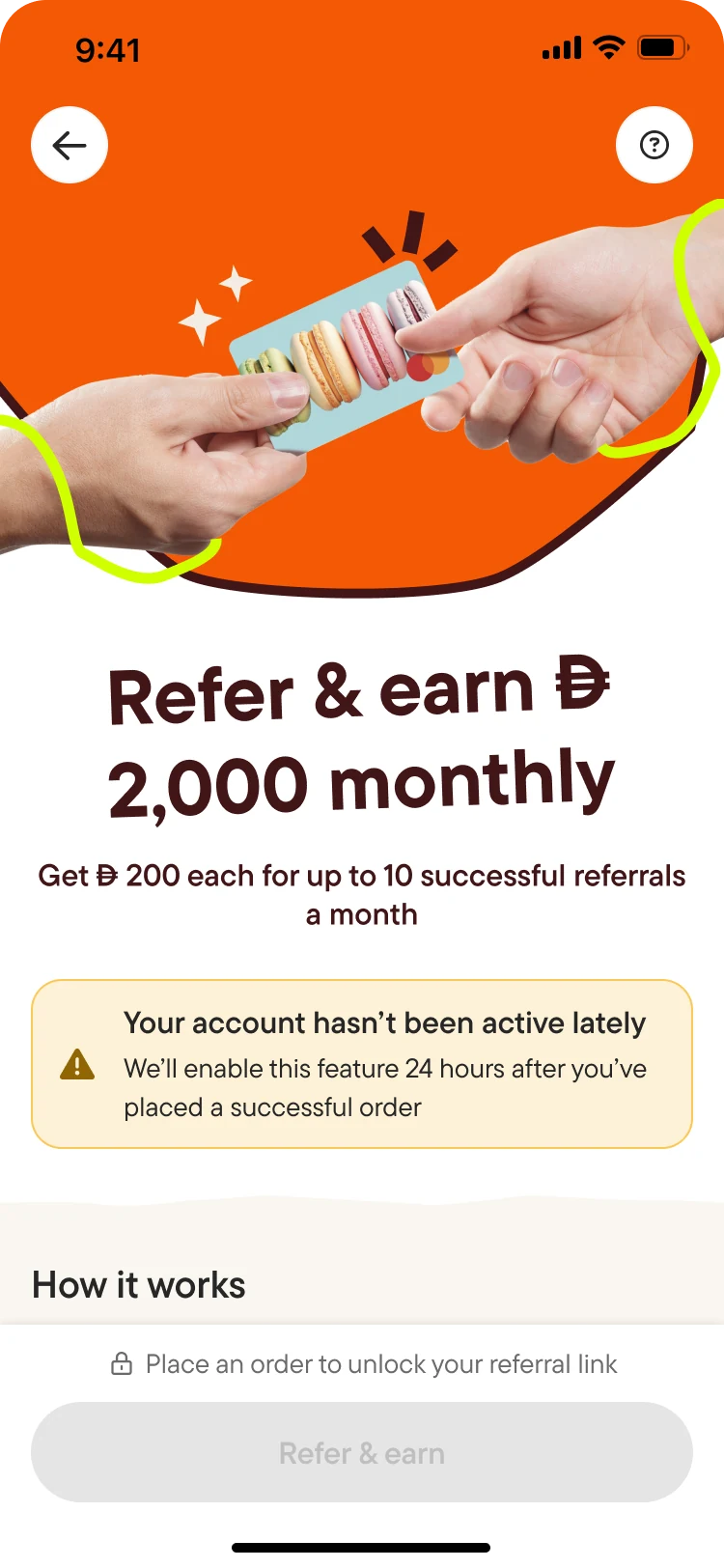
Before launch, I proactively consulted the security team to map the reward exploitation vectors specific to the talabat ecosystem โ€” phone spoofing, multi-account farming, inactive account abuse. Together we defined four eligibility tiers. Each user type gets a tailored version of the RaF landing page, ranging from a gated view with a recovery path to a fully active earnings dashboard.

gated, not
hard-blocked
shows why +
recovery path
unlocks after
first order
AED 0, not
blank state
transparency over
false optimism
State 1 โ€” ineligible user
โ†บ Live prototype ยท tap the CTA
State 01 Ineligible
Phone unverified ยท Not a card holder
The profile identified most likely to abuse the reward โ€” unverified phone, no card history. Rather than a hard block, the screen explains the gate with a contextual warning banner and gives a clear recovery path: place a successful order first. The full value proposition stays visible, so they know what they're working toward.
State 02 Pending
Eligible ยท T&Cs not accepted yet
The CTA is fully tappable. Tapping "Share referral link" triggers two things simultaneously: the page auto-scrolls to the T&Cs checkbox, and a dismissible toast appears at the top โ€” "To share your referral link, you must agree to the terms & conditions." Once the user checks the box it locks (cannot be unchecked), and the CTA activates. No dead ends, no walls โ€” the user reads the full value prop before encountering the consent ask.
State 03 In-progress
Eligible ยท 0 earnings ยท Referrals in-flight
Active referrer with pending conversions. We show AED 0.00 explicitly โ€” not a blank or hidden state. Paired with a live in-progress counter, it signals that the system is tracking accurately. The design bets on transparency: users who trust the counter are more likely to share again rather than feel cheated.
State 04 Active earner
Eligible ยท Active earnings
Referrer with successful conversions. Accumulated earnings are the centrepiece โ€” total credit displayed prominently, broken down by successful and in-progress referrals. Visibility of past success is the strongest driver of repeat sharing behaviour.
๐Ÿ”
Security team consultation

Eligibility criteria were defined jointly before design began โ€” not retrofitted. We mapped three specific exploitation vectors: phone number spoofing for fake referrals, multi-account farming, and inactive accounts created purely to claim the referee reward.

07 ยท Usability Testing

Guerrilla tested with 41 users. One finding reshaped how we thought about the whole program.

Test Setup
Total
41
Participants
Guerrilla usability test on the proposed RaF UX
Group A
23
Active card users
Ordering with the co-branded card on talabat
Group B
18
Inactive card users
Have the card but not paying with it on talabat
Objective ยท Hypotheses
  • Optimize proposed UX for RaF program
  • It is easy to find an entry point to the RaF page
  • Users will understand the value and reward, and be able to send a referral without pain-points
  • Users will feel comfortable sending a referral link to friends/family because the card benefits are clear
Task 1 ยท Navigation
Navigate through the talabat app โ†’ Find the Refer & Earn program
All 41 participants, task started
100%
41
Navigated to Account page (looking for RaF)
78%
32
Of those, dropped (confused platform-level RaF with co-branded program)
47.8%
15
Successfully found the RaF page
8.7%
4
๐Ÿ’ก Key finding
Even though users failed the navigation task, they perceived themselves as successful. They confused the platform-level "Refer a Friend" on the Account page with the co-branded card's referral programme. Entry point discoverability โ€” not program desirability, was the critical gap.
Value Proposition Evaluation
We showed participants the RaF page and asked: how likely are you to participate?
85%
likely to
participate
0255075100%
Top reasons for participation
Value of incentive Clear benefit structure Ease of claiming
Recall of reward value ยท by segment
A Active card users  ยท  23
94%
B Inactive card users  ยท  18
73%
+21pt gap โ€” even inactive card users recall the reward value clearly; the programme has retention potential well beyond active users.
โ†’
Derived hypothesis
When asked how much the referred friend would earn, a high number of participants expected the referee to earn the same referral reward as themselves โ€” confirming that equal perceived value for both parties is the strongest participation driver.
Opportunities Identified
1
Offer equal rewards for both parties
HMW
Meet user expectations of equal referral benefits for referrers and referees, a clear expectation gap identified in the test.
2
Improve and educate on entry points
HMW
Expose entry points for the RaF programme beyond the tpay dashboard, or educate users specifically about the tpay dashboard entry point.
3
Bridge the gap between two RaF programmes
HMW
Manage user expectations around the platform-level Refer a Friend vs the co-branded card's programme; they are not the same, but users assume they are.
๐Ÿ”—
Why this connects to Section 04
The finding that users expected equal rewards for both parties validated the design decision to reposition the welcome bonus as a referee reward. We couldn't deliver equal cash rewards (commercial constraint), but we could deliver equivalent perceived value โ€” and the testing data confirmed users would respond to it. The 68% uplift in welcome bonus qualification after launch proved the hypothesis right.
08 ยท The Impact

Acquisition quality, user behaviour, and platform GMV all moved.

18.8%
of all new cards issued came from referrals
Jan to May 2025
68%
uplift in welcome bonus qualification for referred vs non-referred users
Same period comparison
+23%
GMV uplift: food vertical, active referred users post card approval
Referred vs non-referred cohort
+31%
GMV uplift: non-food verticals, active referred users post card approval
Strongest signal across all verticals
What the GMV data means
Referred users were not just more likely to be approved; they were better users of the platform. The +23%/+31% GMV uplift confirms higher-quality acquisition, not just volume. This closes the original goal of driving talabat ADCB card impact on talabat GMV.
What happened next
The welcome bonus tracker โ€” designed to work around a commercial constraint, performed well enough enough that the product team agreed to replicate it for all card users. A constraint became a platform feature.
The Experience

Every screen, crafted.

Critical moments from the referrer and referee flows, shipped January 2025.

09 ยท What I'd Do Differently

Three honest reflections.

1. Quantify the business case earlier. I would invest time sooner in converting the 10% CTR signal into a projected CAC comparison and GMV opportunity, making the investment case harder to deprioritize.
2. Secure the referee reward earlier. The mid-project budget change was resolved well, but the welcome bonus repositioning consumed design time we could have invested in the referrer experience. Earlier contract on incentive structure would have changed the project economics.
3. Build a pre-defined measurement framework before launch. The GMV and qualification uplift data was gathered, but not to a pre-agreed success definition. A measurement plan agreed upfront would have made the post-launch results more defensible and easier to act on.

Prasenjit Singha

Lead Product Designer
๐Ÿ“ Dubai, UAE โœ‰ prasingharevolution@gmail.com ๐Ÿ”— linkedin.com/in/prasenjit-singha-10b207a0 ๐Ÿ“ž +971 05423 63242
Core skills
Designing & Prototyping
UX/UI & Interaction Design Rapid Prototyping Figma ยท Lovable Mixed-reality UX Voice UX
Research & Analysis
Qualitative Research Quantitative Research Usability Testing Accessibility ยท WCAG
Strategy & Leadership
Workshop Facilitation Stakeholder Alignment Roadmapping Design Mentorship Miro ยท FigJam
Education
B.Des ยท Communication Design
NIFT, Bengaluru ยท 2018
10+2 ยท Commerce
Margherita College ยท 2013
Mentorship

Mentored 3 aspiring product designers end-to-end โ€” from UX fundamentals and storytelling to helping each land their first full-time product design role.

Currently guiding an in-house visual designer through the jump to product design.

Experience
Property Finder ยท Dubai, UAE
Lead Product Designer โ€” Mortgage Finder
Feb 2026 โ€“ Present
Leading design for the Mortgage Finder squad โ€” a core growth vertical connecting property buyers with the right financing options in the UAE market.
talabat (Delivery Hero) ยท Dubai, UAE
Senior Product Designer
Dec 2022 โ€“ Feb 2026
Worked across fintech and q-commerce โ€” leading initiatives touching millions of users across regions, driving alignment between design, product, tech, data, and external partners.
  • Designed and launched DineOut Deals in UAE โ€” a brand-new revenue stream that hit PMF within 9 months.
  • Owned end-to-end co-branded card programme (awareness โ†’ acquisition โ†’ activation โ†’ engagement): 27K+ new cards issued, 30% higher AOV (food), 21% lift in non-food purchases.
  • Led adaptation of card lifecycle journeys for scaling to 2 new MENA markets.
  • Ran 10+ cross-functional workshops with internal teams and banking partners โ€” each unblocked a stuck problem.
  • Co-led tribe-level accessibility initiative: semantic labelling for screen readers shared across the design chapter.
  • Shaped Delivery Hero's global picker app (Pelican) during a 5-day Berlin workshop, addressing a โ‚ฌ3M/month order fulfillment issue.
Threpsi Solutions ยท B2B product Retailio
Product Designer II
Jul 2021 โ€“ Sep 2022
Led execution of core product launches and enhancements across Commerce, Discovery, and Consumer pods.
  • Part of the team that mobilised TAU growth from 5K to 100K+ in a year โ€” redesigned merchant onboarding, ordering, and tracking. Making the platform simpler, faster, and more intuitive.
  • Built an in-house CRM from scratch to replace multiple paid tools, saving the business โ‚น1.2M/month.
Wellnesys Technologies ยท YogiFi
Lead Product Designer
Feb 2020 โ€“ Jul 2021
Owned the full design of the YogiFi app โ€” an AI-powered yoga product that blended software with a smart mat.
  • Collaborated with Apple's UX design evangelists under the App Accelerator Programme to craft one of the first mixed-reality wellness experiences on iOS โ€” 40% increase in active sessions.
  • Built data-feedback loop features that adapted to real posture data, making the experience feel personal, not robotic.
Independent ยท India
Motion & Experience Design Consultant
Jan 2018 โ€“ Jan 2022
Worked with startups and scaled players โ€” Groww, Rupeek, Aditya Birla Group, Pubninja and others โ€” shaping brand motion and end-user journeys as a hands-on collaborator.
Connect with me

Let's build something
people remember.

Open to Design Leadership roles globally.

prasingharevolution@gmail.com
Design preview